Prepared: August 10, 2026. All quotes verified against fetched primary sources; every claim carries a citation. Numbers flagged [headline-only] could not be verified in a fetched primary source and are treated as unconfirmed.
TL;DR
- AI is adopted far less than the hype suggests: 21% of US workers use AI for some of their work (Pew, Oct 2025), up from 16% a year earlier. The famous 75% “knowledge worker” figure is a Microsoft vendor panel, not a representative sample.
- Where AI is used, it measurably helps: controlled experiments show +15% customer-support productivity (QJE 2025), +25% speed for consultants (BCG 2023), 55.8% faster task completion for developers with Copilot (Peng et al. 2023), and 40% less time for professional writing (Science 2023).
- Software development is the most AI-exposed profession, and adoption there is near-universal (Stack Overflow, DORA, Octoverse all show the majority of devs using AI tools by 2025).
- The dev job market is not collapsing: BLS still projects +16% growth for software developers to 2034, wages hold at $133k median, and tech job postings hit a three-year high by mid-2026. But 2026 tech layoffs already surpassed all of 2025 by early August, and entry-level hiring is the most contested segment.
- 1-2 year outlook: flat-to-fragile. Hiring demand is real, but layoff churn and AI-capex cost discipline keep pressure on, and AI-assisted work becomes the default baseline.
- 1-5 year outlook: net positive on headcount per BLS/GS/McKinsey, but the composition changes. Complementarity (AI helping experienced engineers) is the mainstream expert view; the dissenting view is that entry-level demand shrinks as AI absorbs junior-grade work.
1. Adoption reality check: how much is AI actually used at work?
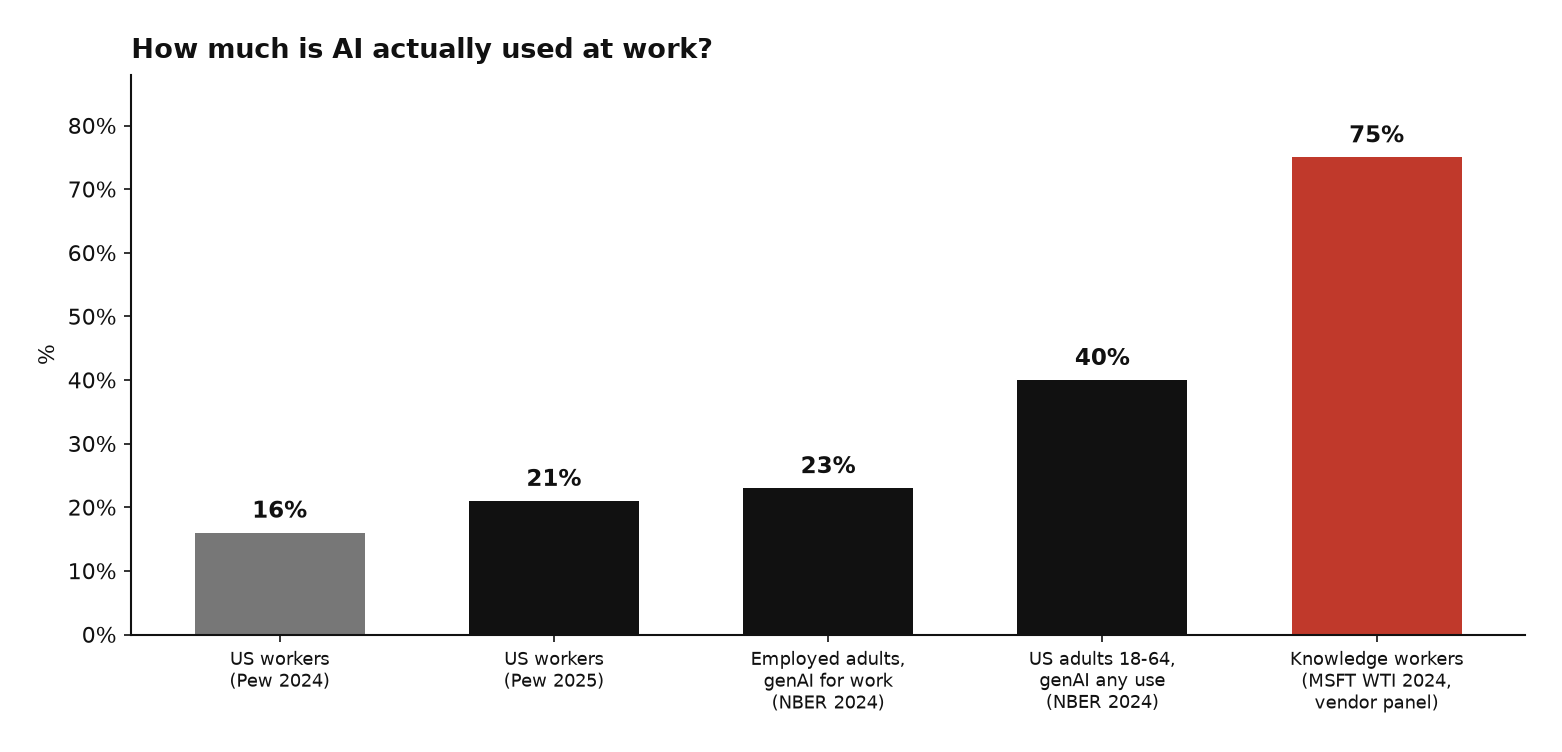
The representative numbers are small but growing.
“Today, 21% of U.S. workers say at least some of their work is done with AI, according to a Pew Research Center survey conducted in September. That share is up from 16% roughly a year ago. Most American workers (65%) still say they don’t use AI much or at all in their job.”
Source: Luona Lin, “About 1 in 5 U.S. workers now use AI in their job, up since last year,” Pew Research Center, Oct 6, 2025. https://www.pewresearch.org/short-reads/2025/10/06/about-1-in-5-us-workers-now-use-ai-in-their-job-up-since-last-year/
“As of late 2024, nearly 40 percent of the U.S. population age 18-64 uses generative AI. 23 percent of employed respondents had used generative AI for work at least once in the previous week, and 9 percent used it every work day. Relative to each technology’s first mass-market product launch, work adoption of generative AI has been as fast as the personal computer (PC), and overall adoption has been faster than either PCs or the internet.”
Source: Alexander Bick, Adam Blandin, David J. Deming, “The Rapid Adoption of Generative AI,” NBER Working Paper 32966, Sept 2024 (rev. Feb 2025). https://www.nber.org/papers/w32966
The vendor number that dominates the press is not comparable.
“Use of generative AI has nearly doubled in the last six months, with 75% of global knowledge workers using it.”
Source: Microsoft Work Trend Index, “AI at Work Is Here. Now Comes the Hard Part,” May 8, 2024. https://www.microsoft.com/en-us/worklab/work-trend-index/ai-at-work-is-here-now-comes-the-hard-part
Microsoft surveys its own knowledge-worker panel; Pew surveys a representative sample of all workers. The 75% vs 21% spread is methodology, and it is routinely laundered in headlines.
Who uses it: AI use concentrates in professional, mid-to-high-wage work. 28% of US workers with a bachelor’s degree or more use AI at work vs 16% with less education (Pew, Oct 2025). Education gradient confirms the direction of the “bleeding edge” intuition in your question: the people building AI products are the ones who use them.
The gap between capability and adoption is now measurable: among workers who don’t currently use AI at work, 36% say at least some of their work could be done with AI (up from 31% in 2024, Pew). Capability perception outruns actual use by a wide margin. Gartner found only 15% of IT application leaders were considering, piloting, or deploying full gen-AI in application software delivery as of Sept 2025 [headline-verified via Gartner newsroom feed; body not retrievable]. McKinsey’s own Dec 2025 report is titled “AI at work but not at scale.”
2. The productivity evidence: does AI actually improve output?
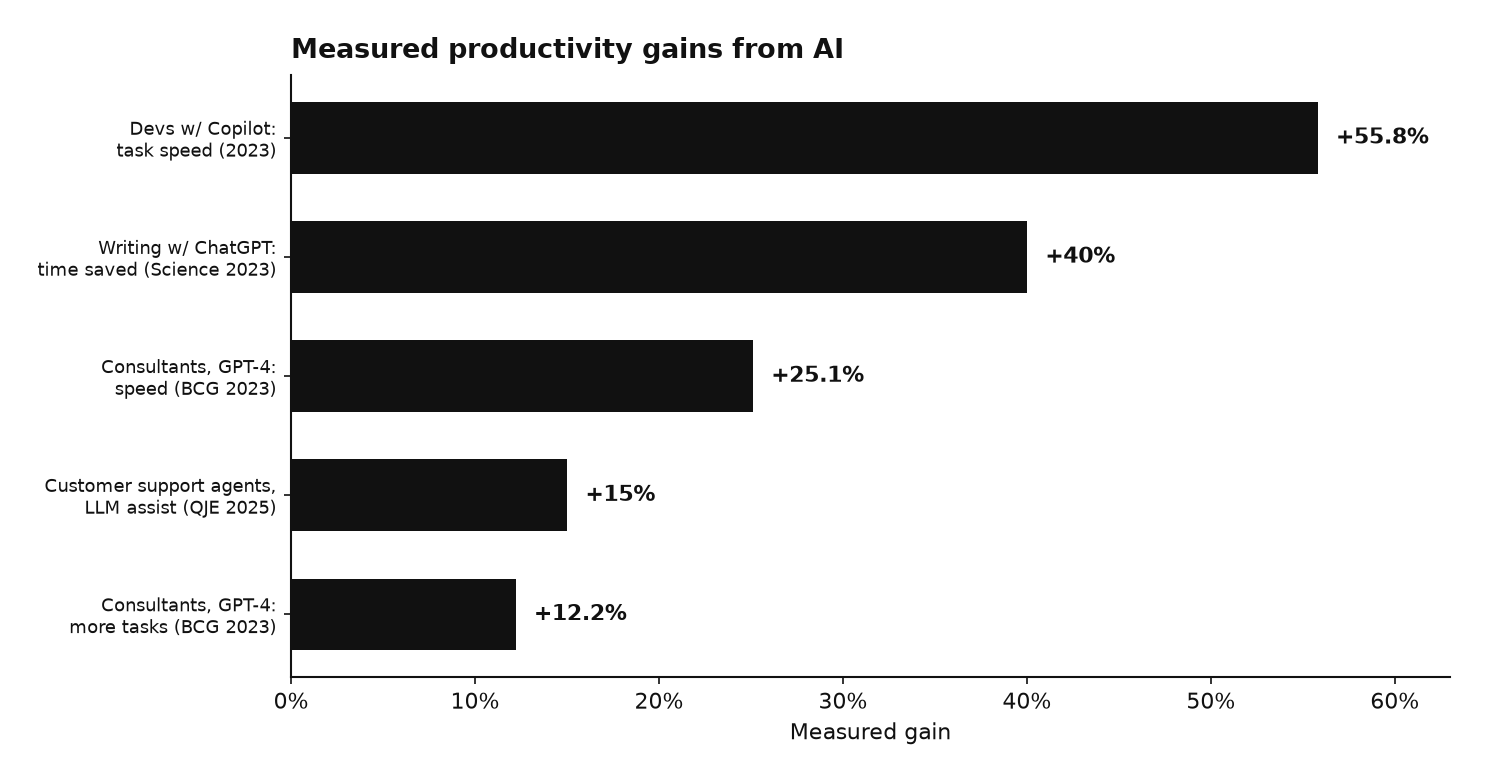
The four canonical controlled studies, all with effect sizes:
| Study | Population | Measured effect |
|---|---|---|
| Brynjolfsson, Li & Raymond, QJE 2025 | 5,172 customer-support agents, Fortune 500 firm | +15% issues resolved per hour (working paper: 14%) |
| Dell’Acqua et al., SSRN 4573321 (BCG “Jagged Frontier”) | 758 knowledge workers | +12.2% tasks completed, +25.1% faster, better quality; but -19% on an out-of-frontier task |
| Peng et al., arXiv 2302.06590 (GitHub Copilot) | 95 developers, HTTP server task | 55.8% faster task completion |
| Noy & Zhang, Science 2023 | 453 college-educated professionals, writing tasks | 40% less time, 18% higher quality |
“Access to AI assistance increases worker productivity, as measured by issues resolved per hour, by 15% on average, with substantial heterogeneity across workers. … Less experienced and lower-skilled workers improve both the speed and quality of their output, while the most experienced and highest-skilled workers see small gains in speed and small declines in quality.”
Source: “Generative AI at Work,” Quarterly Journal of Economics (2025), DOI 10.1093/qje/qjae044; NBER WP 31161.
“The preregistered experiment involved 758 knowledge workers. … subjects using AI outperformed those not using AI, completing 12.2% more tasks and completing them 25.1% more quickly on average while also delivering solutions of significantly improved quality. However, for a complex managerial task selected to be outside the frontier, subjects using AI were 19% less likely to produce correct solutions.”
Source: F. Dell’Acqua et al., “Navigating the Jagged Technological Frontier,” SSRN 4573321 (2023, updated 2024). https://papers.ssrn.com/sol3/papers.cfm?abstract_id=4573321
Honest caveats: these are short-horizon experiments and one-company studies. The Copilot and BCG studies were partly vendor-affiliated. None measures firm-level financial returns. The Brynjolfsson result contains the pattern that matters for careers: AI helps less-experienced workers most on well-defined tasks, and does little for top performers on easy tasks, while hurting performance on tasks outside AI’s frontier.
3. How AI is used at work: augmentation over automation
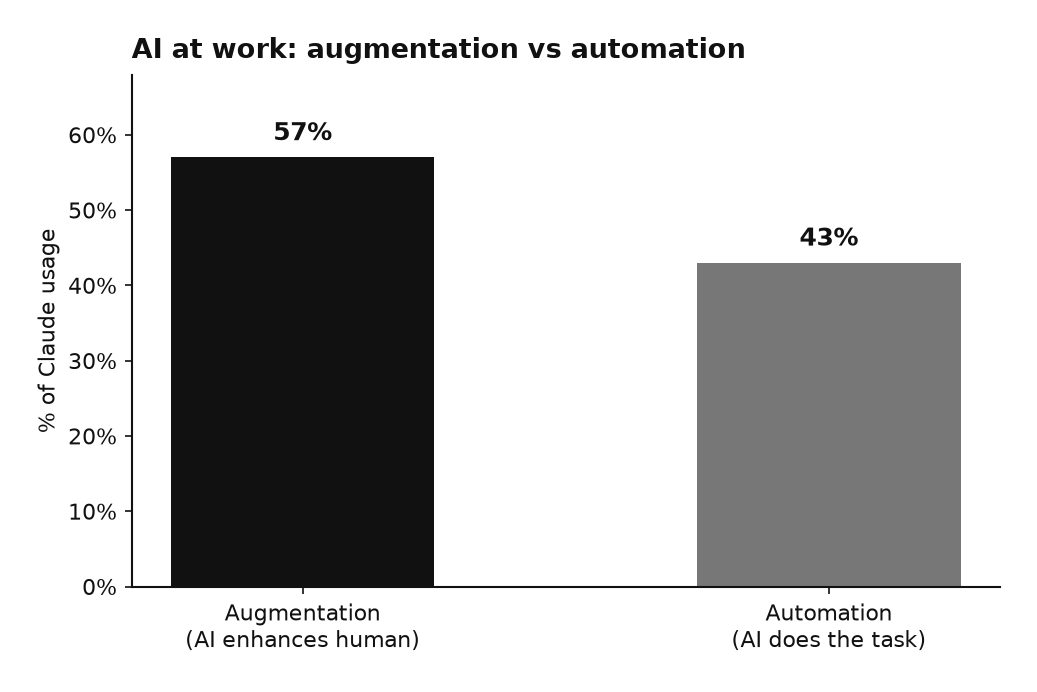
“Over one-third of occupations (roughly 36%) see AI use in at least a quarter of their associated tasks, while approximately 4% of occupations use it across three-quarters of their associated tasks. AI use leans more toward augmentation (57%), where AI collaborates with and enhances human capabilities, compared to automation (43%)…”
Source: Anthropic Economic Index (2025), analysis of ~1M Claude conversations. https://www.anthropic.com/research/the-anthropic-economic-index
Usage concentrates in software development and technical writing; it is highest for mid-to-high-wage professional work and lowest at both wage extremes (Anthropic). Healthcare adoption rose sharply by 2026 (Stanford AI Index 2026 coverage: clinical documentation, medical imaging, diagnostic reasoning).
4. AI in software development: the profession where adoption is real
Adoption among developers is near-universal
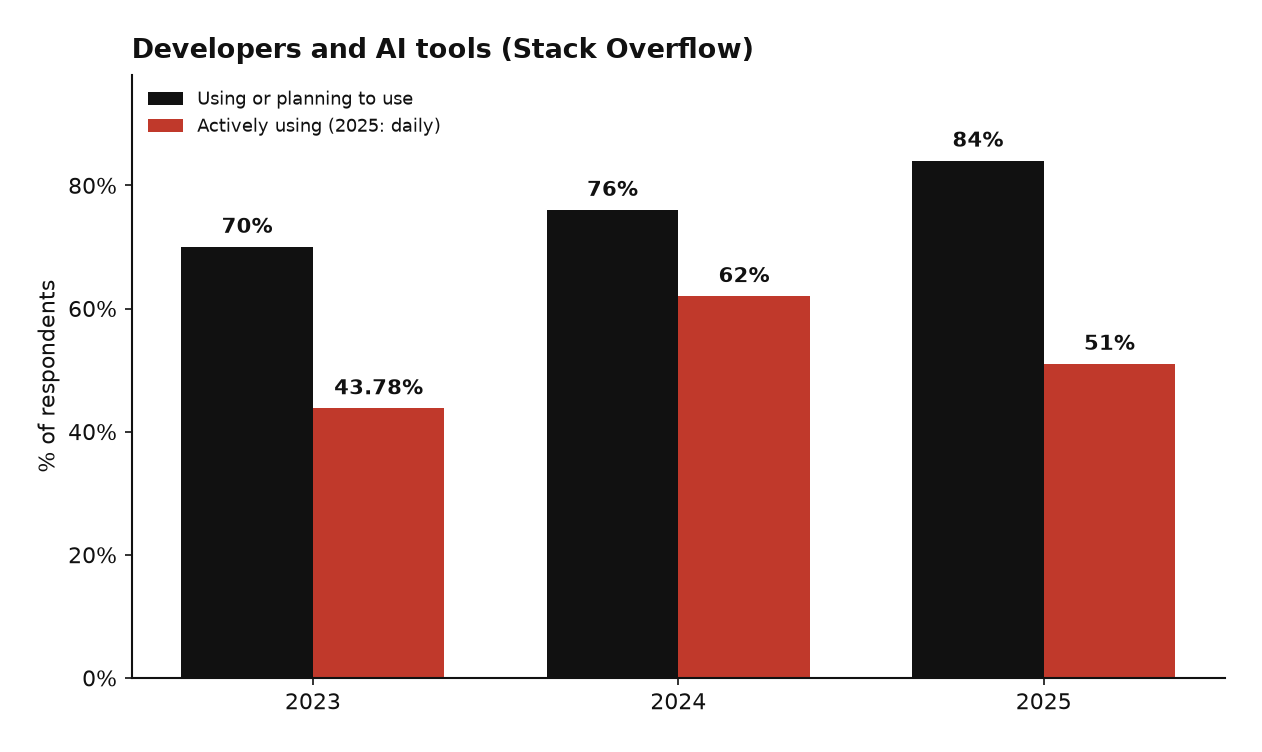
“84% of respondents are using or planning to use AI tools in their development process, an increase over last year (76%). This year we can see 51% of professional developers use AI tools daily.”
Source: Stack Overflow Developer Survey 2025, AI section. Earlier years: 70% (2023), 76% (2024), with active use at 43.78% (2023) and 62% (2024). https://survey.stackoverflow.co/2025/
The sentiment flip matters: positive sentiment toward AI tools fell from 70%+ (2023-2024) to 60% (2025), while distrust of AI accuracy hit 46% vs 33% trust (Stack Overflow 2025).
“The majority of survey respondents (90%) use AI as part of their work and believe (more than 80%) it has increased their productivity. Yet a notable portion (30%) currently report little to no trust in the code generated by AI.” “47% of respondents using AI tools every day.”
Source: DORA / Google Cloud, “State of AI-assisted Software Development 2025” (survey June-July 2025, ~5,000 technology professionals). DORA 2024: 75.9% relied on AI at least in part; 75% reported positive productivity gains.
“80% of new developers on GitHub use Copilot in their first week.” “Every second, more than one new developer on average joined GitHub — over 36 million in the past year. It’s our fastest absolute growth rate yet and 180 million-plus developers now work and build on GitHub.”
Source: GitHub, “Octoverse: A new developer joins GitHub every second as AI leads TypeScript to #1,” Oct 28, 2025. India alone added 5M+ developers (14% of new accounts).
The measured effects: faster, higher quality, but delivery instability
The strongest developer-specific evidence:
| Study | Design | Result |
|---|---|---|
| Peng et al., arXiv 2302.06590 | RCT, 95 devs, HTTP server task | 55.8% faster with Copilot |
| GitHub Copilot code-quality RCT (Oct 2024) | RCT, 202 devs, 5+ yrs experience | 53.2% greater likelihood of passing all 10 unit tests; 13.6% more readable lines; ~1-4% better readability/reliability/maintainability/conciseness; 5% more likely to be approved |
| GitHub Next experiment (Sept 2022) | 2,000+ survey + experiment | 78% vs 70% task completion with Copilot |
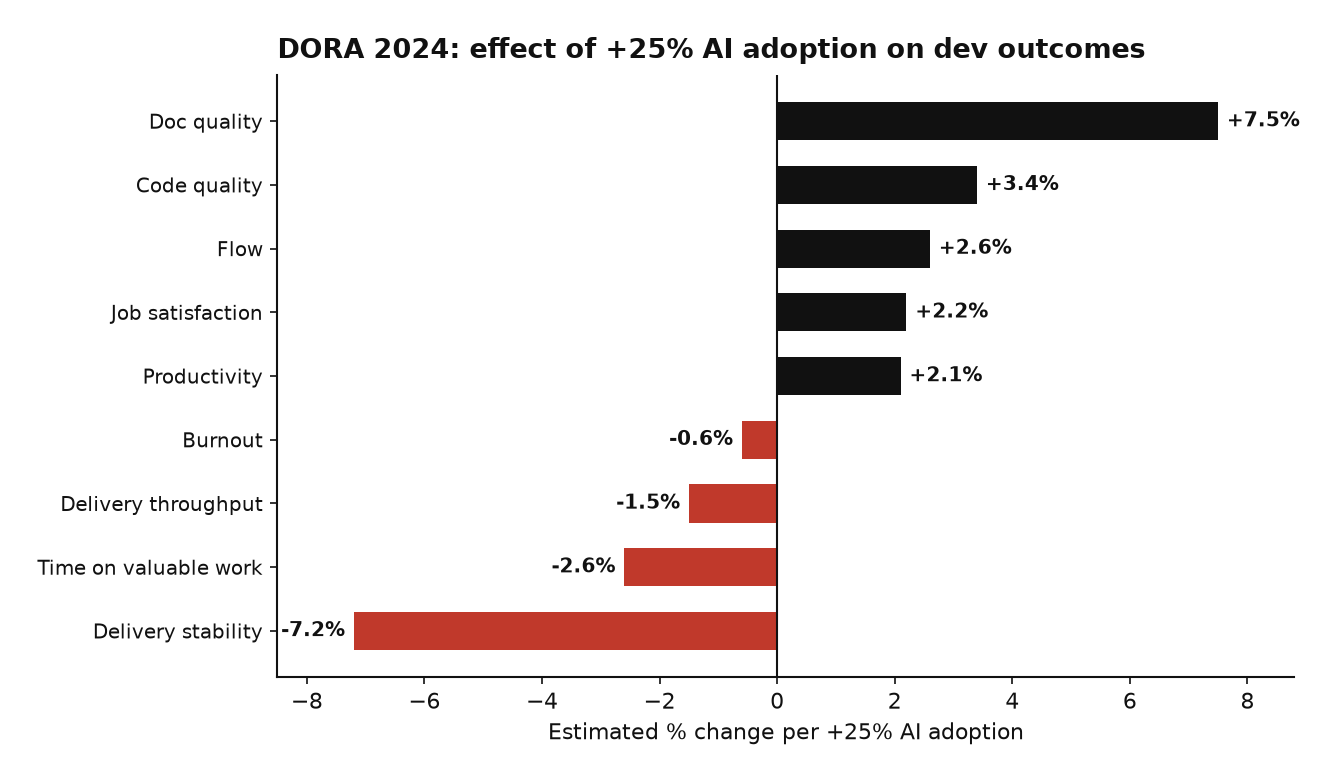
| DORA 2024 | Survey, early 2024 | Per +25% AI adoption: productivity +2.1%, flow +2.6%, job satisfaction +2.2%, code quality +3.4%, doc quality +7.5%; BUT delivery throughput -1.5%, stability -7.2% |
| DORA 2025 | Survey, mid-2025 | Throughput reversed to positive; instability still negative; 30% little/no trust in AI code |
“In the study, we recruited 202 developers with at least five years of experience. Half were randomly assigned GitHub Copilot access and the other half were instructed not to use any AI tools.” “developers with GitHub Copilot access had a 53.2% greater likelihood of passing all 10 unit tests in the study (p<0.01).”
Source: GitHub Blog, “Does GitHub Copilot improve code quality? Here’s what the data says,” Oct 2024. https://github.blog/news-insights/research/does-github-copilot-improve-code-quality-heres-what-the-data-says/
“The negative impact on delivery stability is larger (an estimated 7.2% reduction for every 25% increase in AI adoption).”
Source: DORA, 2024 Accelerate State of DevOps Report. The authors were surprised; their hypothesis was that AI-enabled larger change batches violate DORA’s small-batch principle.
A perception-reality warning for anyone relying on AI speed: METR (cited in DORA 2025) found “developers who were slowed down by AI tools by 19% still believed the tools had made them 20% more efficient.”
Capability is climbing fast: SWE-bench
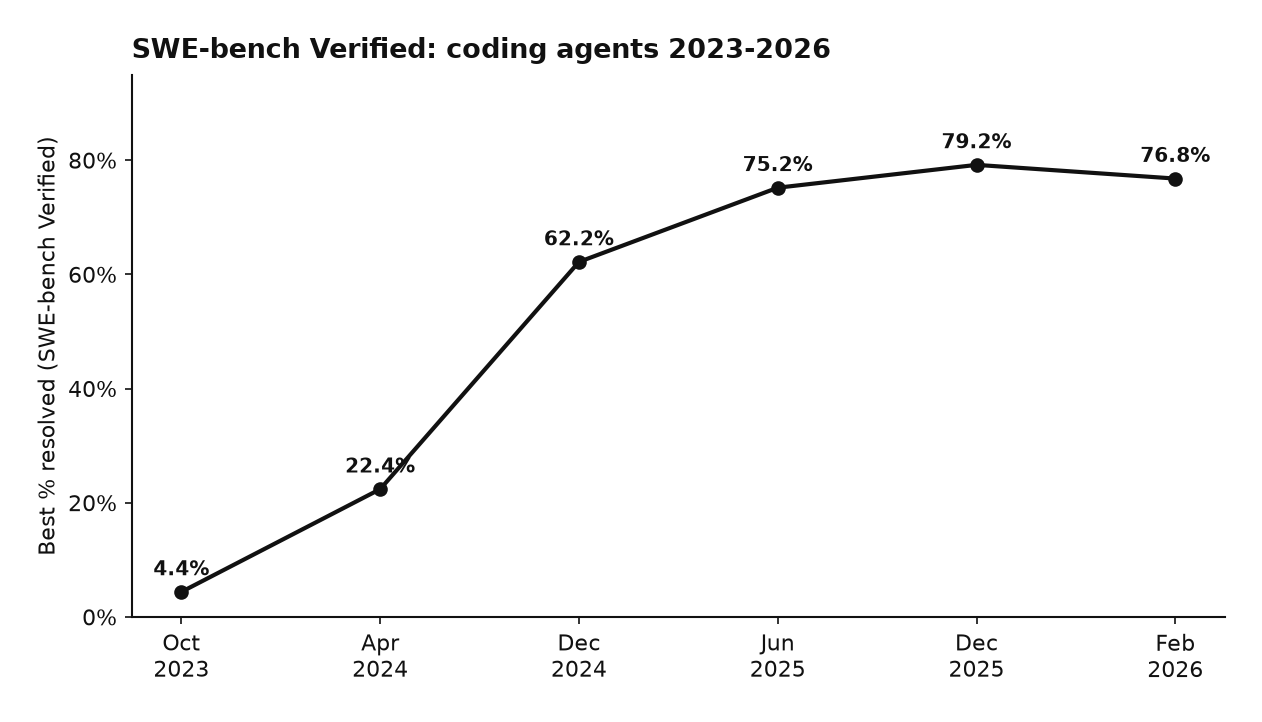
Best verified score on SWE-bench (real GitHub issues to fix): 4.4% (Oct 2023) -> 79.2% (Dec 2025), per the swebench.com leaderboard fetched Aug 10, 2026. These are agent+model systems (SWE-agent + GPT-4, TRAE, Sonar + Claude 4.5 Opus), self-reported. The leader moves every few months; the trend line is what matters.
The junior-developer question
GitHub’s Octoverse 2025 research on how AI changed teams:
“junior developers ramp faster, and senior developers spend less time on toil and more on architecture.” “Juniors ship faster than seniors can review.”
Source: Idan Gazit, GitHub Next lead, in Octoverse 2025 coverage.
GitHub’s identity research describes advanced AI users moving “from code producers to creative directors of code,” while stressing “deep technical understanding remains essential… to evaluate complex output, diagnose hidden issues, and determine whether an AI-generated solution is sound.” (Octoverse 2025)
The famous “~46% of code on GitHub is AI-generated” claim (attributed to GitHub CEO Thomas Dohmke) could NOT be verified in any primary source fetched for this report, so it is not used as a fact. The same goes for the Stanford AI Index “31% drop in junior job postings” figure: it was not retrievable from a primary source this session.
Peng et al.’s abstract does note: “heterogenous effects show promise for AI pair programmers to help people transition into software development careers.”
5. The developer job market: trends, wages, layoffs
Employment is still growing on the official numbers
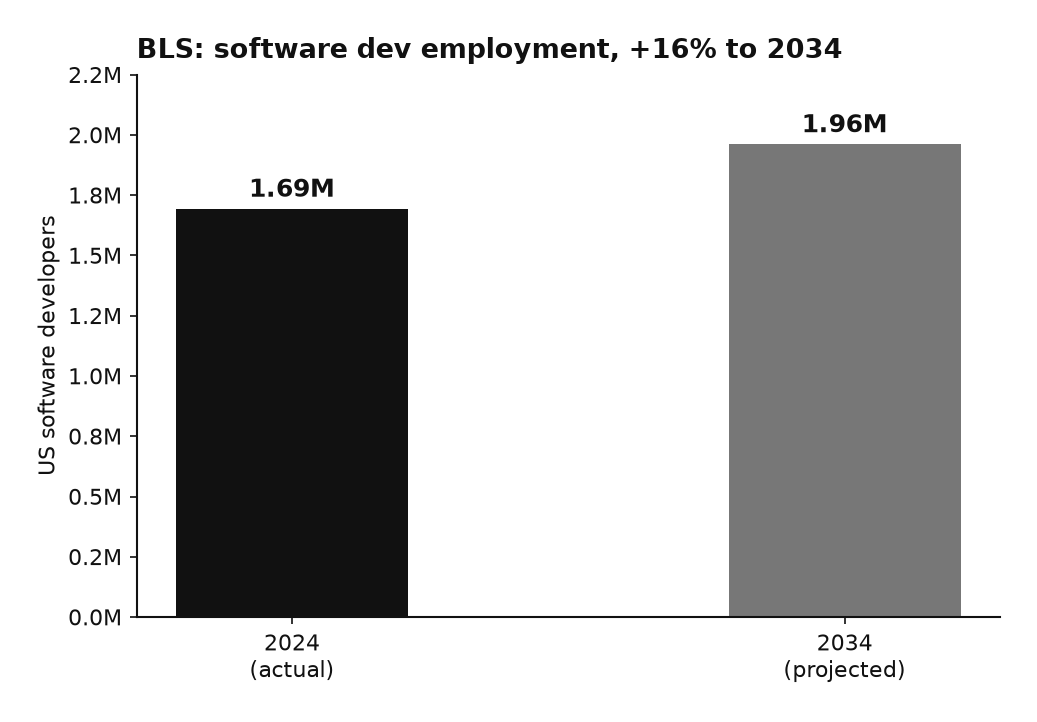
“Overall employment of software developers, quality assurance analysts, and testers is projected to grow 15 percent from 2024 to 2034, much faster than the average for all occupations.”
“2024 Median Pay — $131,450 per year… Number of Jobs, 2024 — 1,895,500… Employment Change, 2024–34 — 287,900”
Source: BLS Occupational Outlook Handbook, “Software Developers, Quality Assurance Analysts, and Testers.” https://www.bls.gov/ooh/computer-and-information-technology/software-developers.htm
Important detail: BLS revised the projection DOWN between cycles, from +17% (2023-2033, 2,225,000 target) to +15% (2024-2034, 2,183,300 target). First markdown in decades. Still “much faster than average” vs 3% for all occupations, and about 129,200 annual openings projected.
Layoffs: 2026 has already exceeded 2025
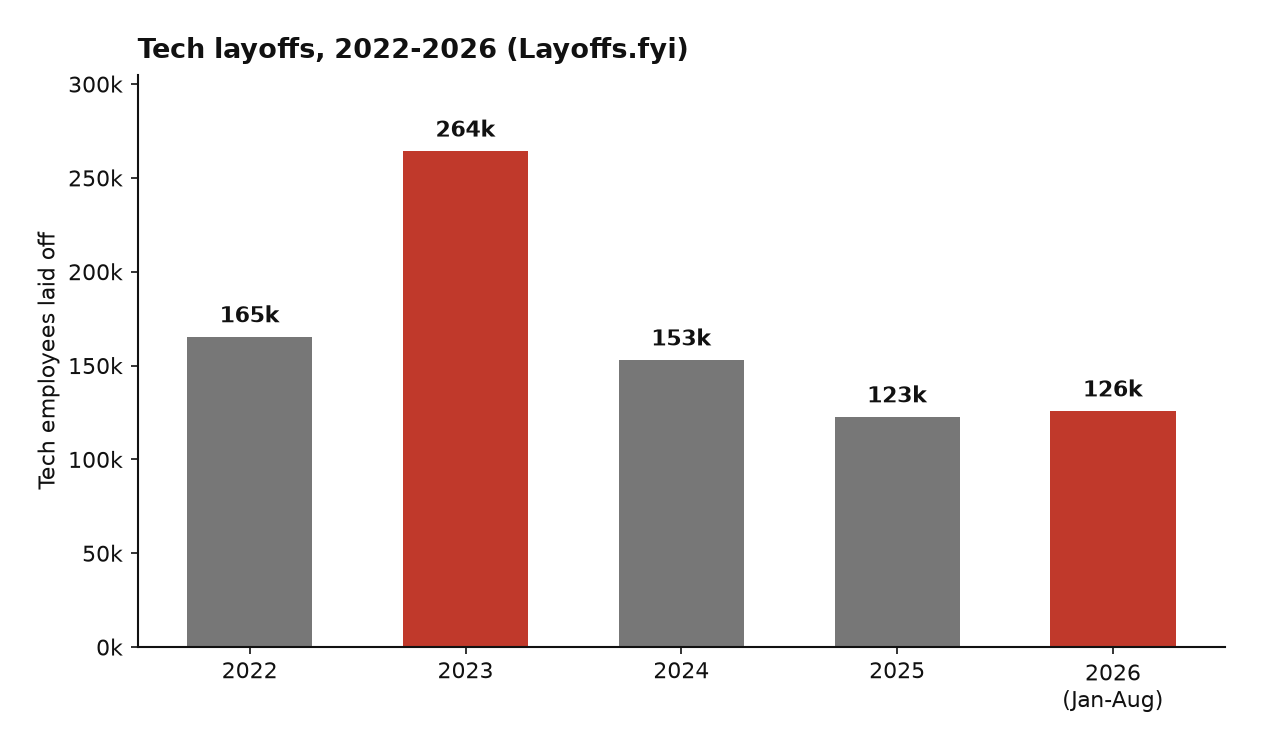
“Tech layoffs in 2026 have already surpassed last year’s total as of 6 August, with 125,759 employees affected across 264 companies, according to Layoffs.fyi data.”
“Layoffs.fyi recorded 122,606 technology-sector employees losing their jobs across 278 companies during all of 2025.”
Source: Clarizza Potoy, IBTimes UK, Aug 8, 2026.
Year-by-year (Layoffs.fyi): 2022: 165,269 · 2023: 264,220 (peak) · 2024: 152,922 (revised) · 2025: 122,606 · 2026 YTD (through Aug 6): 125,759.
AI’s role in layoffs is real but contested: CompTIA’s November 2025 survey found 64% of companies acknowledge “using AI as cover for staffing decisions, such as hiring freezes or layoffs” (reported Jan 9, 2026). Companies publicly distance cuts from AI; Challenger says AI is “the most cited reason” for job cuts but “isn’t a ‘jobpocalypse’ yet” [headline-level].
Wages: flat at all-time highs
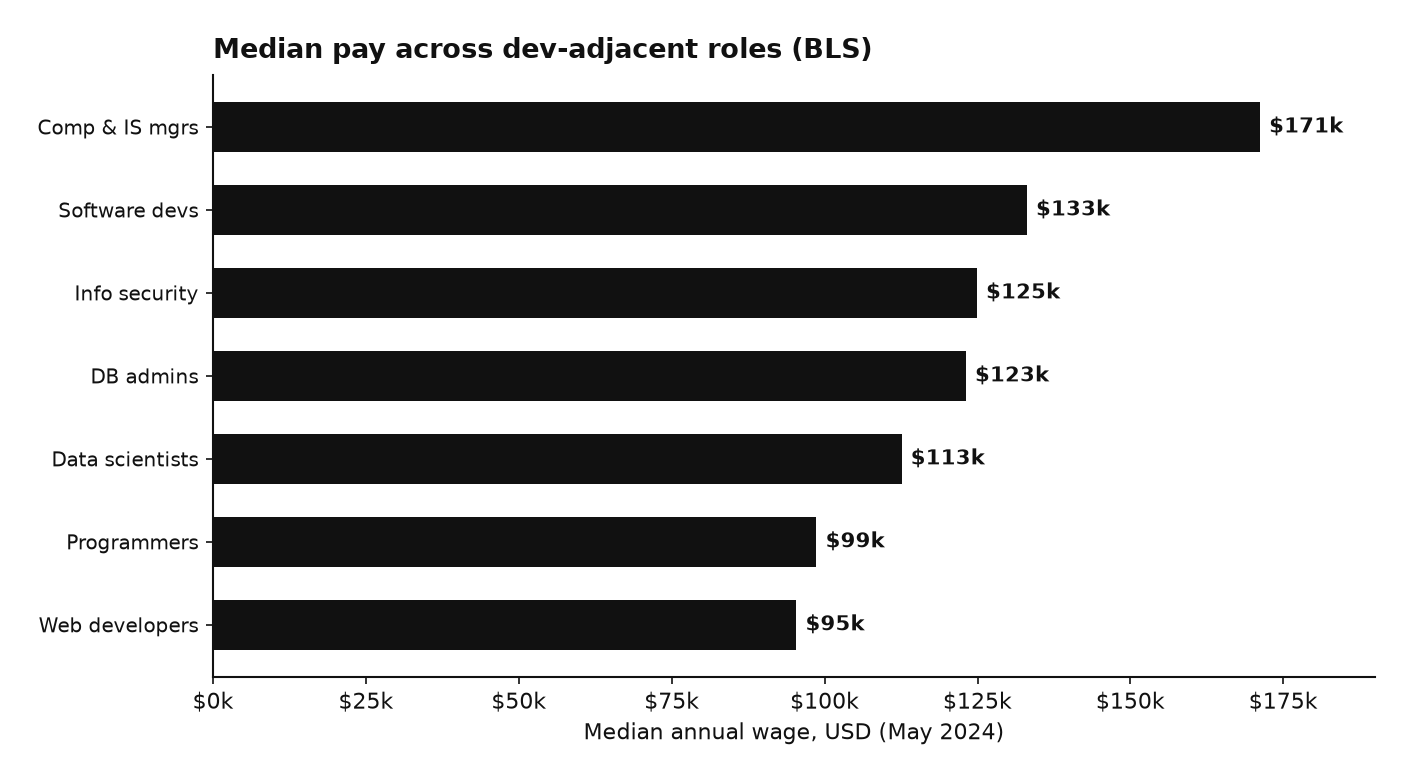
“The median annual wage for software developers was $133,080 in May 2024.”
Source: BLS OEWS May 2024, via BLS OOH.
Software dev median was flat between May 2023 and May 2024 - the first stall after years of rapid growth. Web developers & digital designers: 98,670. All occupations: $49,500.
Postings: three-year high, but a choppy ride
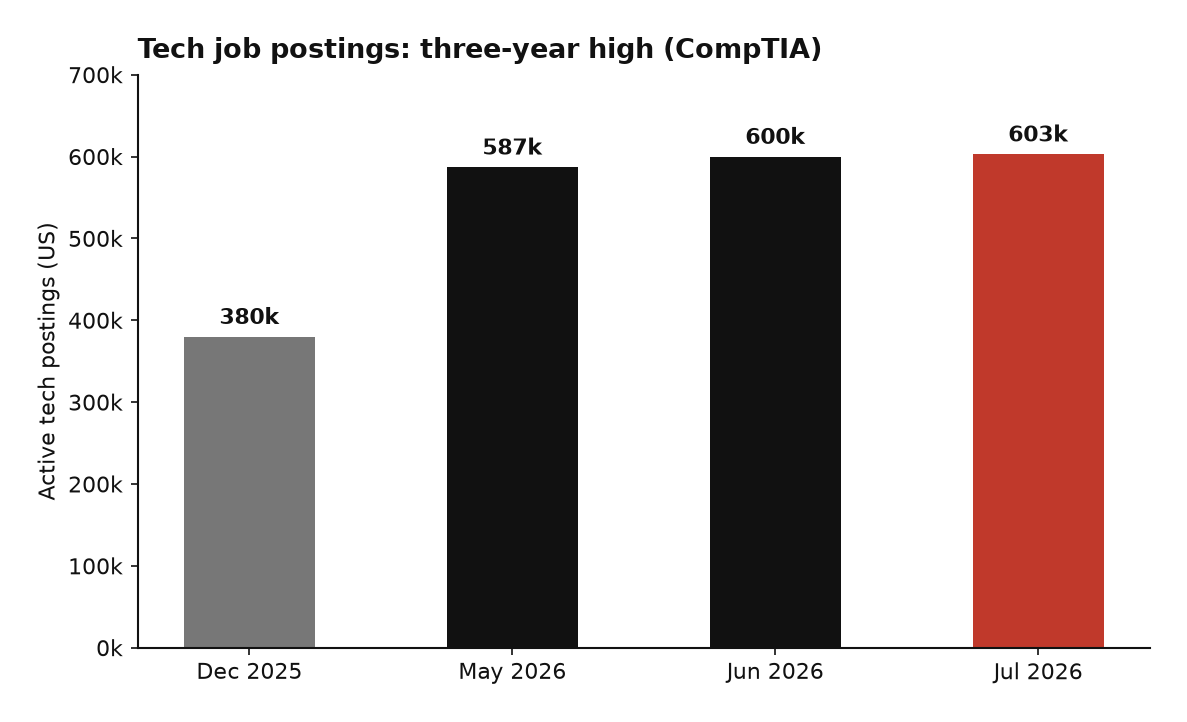
CompTIA monthly series: active tech postings fell to ~380k (Dec 2025), then climbed to 587k (May 2026), 600k+ (Jun 2026), 603k (Jul 2026) - a three-year high. Software developer postings: 46,082 in July 2026, the single largest role. Tech-occupation unemployment fell to 2.8% (Jul 2026) vs 4.2% national. AI-skill postings +111% YoY (Dec 2025). [headline: “AI skills now listed in 73% of tech job postings”, CIO Dive Jul 2026]
Entry level: the contested segment
Direct data is thin; the strongest sourced points:
- Etsy’s Aug 2026 round of ~220 “mainly affected its Product and Engineering teams” (IBTimes).
- Amazon cut “more than 1,800 engineers” in Nov 2025 (CNBC headline).
- 10th-percentile software developer wage: $79,850 - the closest anchor for entry-level pay (BLS).
- Headline-only: “Entry-Level Tech Jobs 2026: 148,092 Cuts” (Tech Times, Jun 2026); “Burnout, frustration and heartbreak: Amazon layoffs take their toll in saturated job market” (CNBC, Jul 2026).
Assessment from available data: entry level is where AI-cover freezes hit first and where the 2022-2024 over-hiring concentrated. The door is not closed (46k SWE postings in a month), but it is narrower than 2021-2022.
6. Outlook: 1-2 years and 1-5 years
The institutional forecasts
| Source | Forecast | Horizon |
|---|---|---|
| BLS OOH | Software devs +16% (1.69M -> 1.96M), 129k annual openings | 2024-2034 |
| Gartner | 75% of enterprise software engineers will use AI code assistants by 2028 (from <10% early 2023) | by 2028 |
| Goldman Sachs | 300M full-time jobs exposed to AI automation; but “most jobs… more likely to be complemented rather than substituted” | long-run |
| McKinsey | 12M additional US occupational shifts by 2030, concentrated in low-wage service work; “adding more tech workers in every sector” | by 2030 |
| IMF | Advanced economies first to feel AI’s effects due to cognitive-intensive employment structure; inequality risk | medium-term |
1-2 years (to ~2028): flat-to-fragile with real demand
- CompTIA (Jul 2, 2026): “Technology occupation employment posted gains in June and new tech job postings increased for the sixth consecutive month, indicating that demand for technology skills remains resilient.” Seth Robinson: “Even as some tech companies announce layoffs, employers in other industries are accelerating digital transformation initiatives and moving from AI experimentation to implementation.”
- ZipRecruiter’s Nicole Bachaud (SF Chronicle, Jul 31, 2026): AI will be a “net job creator, rather than a job killer. While layoffs are increasing, the hiring rate has also risen, signaling that employers… are seeing greater churn as AI disrupts the work done within jobs more than it changes the overall headcount.”
- Gartner: by 2028, AI-assisted development is the default requirement, not a differentiator.
- Beacon Economics’ Christopher Thornberg (Jul 2026): “The tons of money into AI — it’s too much, too fast, too soon” - the capex cycle carries bubble risk that could intensify or reverse the current cost-cutting.
1-5 years (to ~2030-2031): net positive on headcount, negative on the easy path
- BLS: +15% growth 2024-2034 - slower than before but strongly positive.
- Goldman Sachs: complementarity base case; “more than 85% of employment growth over the last 80 years is explained by the technology-driven creation of new positions.”
- McKinsey: digitization “will require adding more tech workers in every sector.”
- Dissenting view (IMF + CompTIA + Musk headline): the risk is skill-structure, not headcount. AI may compress demand for the junior-grade portion of the work ladder precisely while senior work stays scarce. [Musk “coding will be dead” quote is headline-only and should be treated as provocation, not analysis.]
- What is not forecast anywhere in the verified sources: a net decline in software developer employment over the next five years.
7. Bottom line for a fresh CS graduate
- The layoff headlines are not “the end of software.” Every major institutional forecast (BLS, Goldman Sachs, McKinsey) is net-positive on tech employment over 3-5 years.
- They are “the end of the easy path.” First jobs are harder to get than for the 2021-2022 cohorts, the median pay is flat, and AI fluency is becoming table stakes.
- Position: demonstrated project work, AI-assisted development fluency, and specialization (security, data, AI/ML are the fastest-growing posting categories per CompTIA) are the clearest differentiators.
- The single most career-relevant study finding: AI helps less-experienced workers most on well-defined tasks (Brynjolfsson QJE 2025) - but only when they use it, and it hurts on tasks outside AI’s frontier. The skill is knowing which is which.
Sources
- Pew Research Center, “About 1 in 5 U.S. workers now use AI in their job” (Oct 6, 2025) - https://www.pewresearch.org/short-reads/2025/10/06/about-1-in-5-us-workers-now-use-ai-in-their-job-up-since-last-year/
- Bick, Blandin & Deming, “The Rapid Adoption of Generative AI,” NBER WP 32966 (2024) - https://www.nber.org/papers/w32966
- Microsoft Work Trend Index (May 8, 2024) - https://www.microsoft.com/en-us/worklab/work-trend-index/ai-at-work-is-here-now-comes-the-hard-part
- Brynjolfsson, Li & Raymond, “Generative AI at Work,” QJE 2025, DOI 10.1093/qje/qjae044 - https://www.nber.org/papers/w31161
- Dell’Acqua et al., “Navigating the Jagged Technological Frontier,” SSRN 4573321 - https://papers.ssrn.com/sol3/papers.cfm?abstract_id=4573321
- Peng et al., “The Impact of AI on Developer Productivity,” arXiv 2302.06590 - https://arxiv.org/abs/2302.06590
- Noy & Zhang, “Experimental evidence on the productivity effects of generative AI,” Science 381(6654), DOI 10.1126/science.adh2586
- Anthropic Economic Index (2025) - https://www.anthropic.com/research/the-anthropic-economic-index
- BLS Occupational Outlook Handbook, Software Developers (2024-2034) - https://www.bls.gov/ooh/computer-and-information-technology/software-developers.htm
- Layoffs.fyi tracker (Wayback captures 2025-01-01, 2025-05-30, 2025-12-19) - https://layoffs.fyi/
- IBTimes UK, “Tech Layoffs in 2026 Already Beat Last Year’s Total” (Aug 8, 2026) - https://www.ibtimes.co.uk/tech-layoffs-2026-zillow-tiktok-etsy-google-1813127
- SF Chronicle via Yahoo Finance, “This year’s tech layoffs have already surpassed all of 2025” (Jul 31, 2026)
- CompTIA Tech Jobs Report (Jan 9, Jun 5, Jul 2, Aug 7 2026 releases)
- Gartner press release, “75% of Enterprise Software Engineers Will Use AI Code Assistants by 2028” (Apr 11, 2024) - https://www.gartner.com/en/newsroom/press-releases/2024-04-11-gartner-says-75-percent-of-enterprise-software-engineers-will-use-ai-code-assistants-by-2028
- Goldman Sachs Research, “Generative AI could raise global GDP by 7%” (Apr 5, 2023)
- McKinsey Global Institute, “Generative AI and the future of work in America” (Jul 2023)
- IMF Staff Discussion Note 2024/001, “Gen-AI: Artificial Intelligence and the Future of Work” (Jan 14, 2024)
- Stanford HAI AI Index 2026 report page - https://aiindex.stanford.edu/report/
- Stack Overflow Developer Survey 2023, 2024, 2025, AI sections - https://survey.stackoverflow.co/2025/
- DORA / Google Cloud, “2024 Accelerate State of DevOps Report” - https://dora.dev/research/2024/dora-report/
- DORA / Google Cloud, “State of AI-assisted Software Development 2025” - https://dora.dev/research/2025/
- GitHub, “Octoverse: A new developer joins GitHub every second as AI leads TypeScript to #1” (Oct 28, 2025) - https://github.blog/news-insights/octoverse/octoverse-a-new-developer-joins-github-every-second-as-ai-leads-typescript-to-1/
- GitHub Blog, “Does GitHub Copilot improve code quality? Here’s what the data says” (Oct 2024) - https://github.blog/news-insights/research/does-github-copilot-improve-code-quality-heres-what-the-data-says/
- GitHub Blog, “Research: quantifying GitHub Copilot’s impact on developer productivity and happiness” (Sept 7, 2022) - https://github.blog/news-insights/research/research-quantifying-github-copilots-impact-on-developer-productivity-and-happiness/
- SWE-bench leaderboard - https://swebench.com/ (fetched Aug 10, 2026)
- CompTIA survey, “AI’s Impact on Productivity and the Workforce” (Nov 2025), reported in CompTIA Tech Jobs Report (Jan 9, 2026)